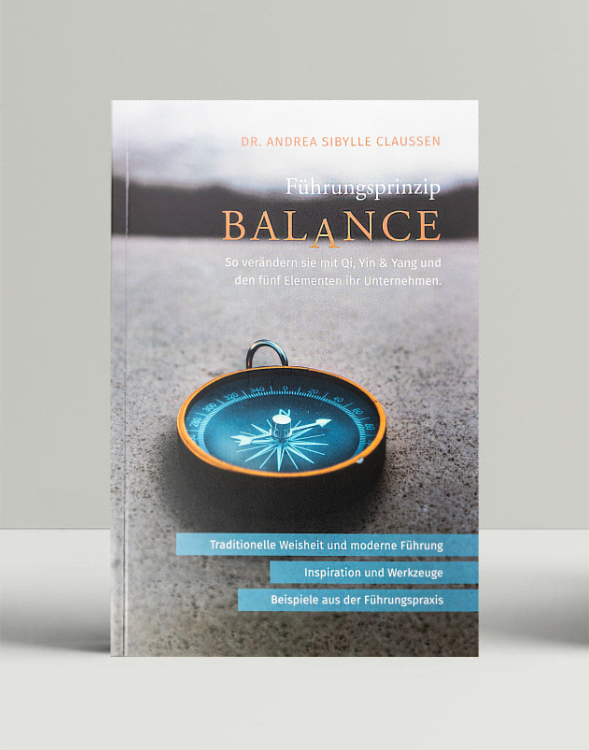
My August 2026 reading journal turns to Andrea Sibylle Claussen’s Führungsprinzip Balance: So verändern sie mit Qi, Yin & Yang und den fünf Elementen ihr Unternehmen, with a question that reaches into both work and everyday life: how do we know when to keep pushing and when to pause?
Action is often our first response to difficulty. A new rule, another meeting, an earlier deadline—each makes progress feel visible. Yet activity does not necessarily improve a situation. The rush to resolve a problem can obscure how it arose, while a new measure may become another burden for someone else.
Listening to the System’s Response
Claussen uses the image of a living body to approach organizations, bringing Qi, Yin and Yang, and the five elements into leadership. What interests me in this perspective is the shift of attention from an isolated result toward the conditions and relationships that produce it.
A team’s exhaustion may concern individual circumstances, but also workloads, communication, and inadequate resources. Asking one person to adjust cannot always change the arrangement that keeps exhausting them. Likewise, completing a task does not establish that the way it was completed can be sustained.
I therefore want to observe how a system responds to an intervention. Does a new rule make cooperation clearer, or make people quieter? Does faster work produce more errors? When a goal is achieved, are people still willing to participate? Such changes can reveal when a method is losing its usefulness.
This gives deliberate non-action a practical meaning. Waiting can involve listening, gathering information, and regulating the impulse to intervene. It needs reasons and boundaries: why wait, when reconsider, and what would require immediate action? Without these, silence can leave others carrying uncertainty or conceal an avoidance of responsibility.
How a Pause Can Participate in Change
I find balance useful as the ability to adjust a rhythm. Urgent failures require a response; major changes need time for consolidation. The difficulty is that emergency habits can persist until urgency becomes an ordinary expectation and calm begins to look like insufficient commitment.
I recognize a similar pattern in my own life. I may add goals because slowing down feels uncomfortable. My calendar fills while my attention fragments. Before organizing time more efficiently, I need to examine which commitments still deserve it.
This brings learning and neuroplasticity into the reflection. The nervous system can undergo functional or structural changes with experience; learning is one expression of that capacity. Habits can change, although change is neither necessarily easy nor always beneficial.
A study of keypress-sequence learning offers a specific connection. Researchers observed neural replay during healthy volunteers’ brief rests associated with gains between practice periods. The finding concerns a particular experimental task and cannot directly establish a management recommendation, but it gives me a reason to take the intervals between practice seriously.
My own extension is to allow experience to become understandable. After a conversation, I can revisit where I rushed to judgment. After a trial, I can compare the new method with the old one. When every experience immediately gives way to another task, I may accumulate activity without noticing what it reveals.
Asking Who Bears the Cost
A pause also requires material conditions. Staffing, reasonable workloads, trustworthy communication, and room to refuse unreasonable demands affect whether someone can adjust their pace at all. I want these conditions included in discussions of vitality, alongside personal reflection.
When assessing an improvement, I therefore want to ask whose situation improves and whose burden grows. A shorter meeting may help, but less so if it creates more invisible clarification afterward.
This question leads to power within organizations. An arrangement that feels stable to management may impose continuing pressure on others. Conflict can be the moment those costs become visible. Asking for harmony before understanding the disagreement may suppress precisely the information that needs attention.
The bodily metaphor can help me notice relationships, but people have different interests and a right to question shared objectives. A balance worth maintaining should allow workloads to be discussed, harm to be raised, and disputed decisions to be reviewed. Otherwise, balance risks becoming one party’s description of the status quo.
Extending the Question to the Land We Depend On
Once I ask who carries the cost, the reflection moves beyond the organization. Where do its resources come from? What remains after they are consumed? Whose lives absorb pollution and depletion? Smooth internal cooperation cannot answer these questions on its own.
Bodily tension, team exhaustion, and ecological damage require different knowledge and evidence. They nevertheless remind me that concentrating exclusively on an established goal can diminish attention to the conditions surrounding it.
I want ecological costs to influence the scale and direction of work, just as exhaustion should influence workloads. Sometimes this requires changing a goal rather than finding a more efficient way to reach it. Personal relaxation cannot resolve unfair resource distribution, and team harmony cannot cancel environmental losses. Different forms of feedback call for different responsibilities.
Qi and the five elements may offer a vocabulary for noticing relationships, but a metaphor still needs to be tested against experience. I want to use it to begin an inquiry, then revise judgments through limited changes, observable results, and other people’s accounts. Intuition can prompt investigation while leaving room for evidence to change the conclusion.
Keeping the Rhythm Adjustable
What I want to practice is a brief pause when pressure arrives: consider what I know, what remains uncertain, and who will bear the consequences of the next action. Then give the pause an endpoint, so observation returns to decision and decision remains open to review.
I do not expect to discover a permanent point of balance. I hope to retain the ability to notice, discuss, and adjust as circumstances change, rather than simply applying more effort to a familiar pattern.
The question I want to keep is: does this way of working preserve the conditions that make good work possible?