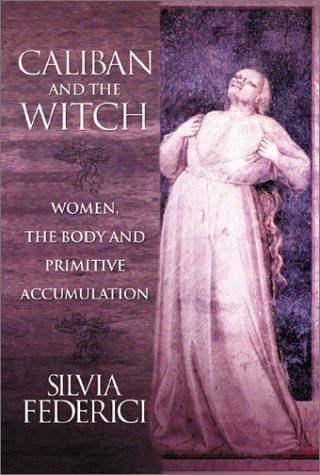
My February reading entry is Silvia Federici’s Caliban and the Witch. It makes me reconsider an ordinary question: when we say someone is working, which activities do we include, and which forms of labor sustaining life do we leave outside?
Reading Notes: Returning Hidden Labor to History
Federici reinterprets the emergence of capitalism from a feminist perspective, emphasizing unpaid reproductive labor and the gendered division of work. She connects enclosure, bodily discipline, and witch-hunting to this process. Reproduction here includes sustaining life, care, and raising children, rather than childbirth alone.
This is the author’s historical argument. The causes of particular witch persecutions require attention to region, period, and evidence; a broad explanation cannot become a ready answer to every case. What follows is my own reflection prompted by the reading.
Enclosure Changes More Than Ownership
Within Federici’s framework, enclosure and the loss of livelihoods help reorganize dependence. My further question is how losing a way to survive changes the capacity to negotiate.
Someone may formally refuse a job, yet face a much higher cost of refusal when other routes to food and housing disappear. Consent in a contract cannot fully describe freedom within the relationship. We also need to ask how long each party can wait and where each can go after leaving.
This makes support networks politically significant. Shared resources, mutual aid, and public services can preserve conditions for survival beyond a single employment relationship. But older communities should not become imagined paradises of equality: they can exclude members and suppress disagreement. What deserves protection is the capacity to widen practical choices while examining power within the community itself.
Labor-Power Does Not Appear by Itself
I understand reproduction as a process to investigate concretely: how does someone grow into a person able to work, and how do they recover after daily expenditure?
There is an important conceptual distinction. An activity being indispensable to production does not automatically establish that it creates value in the same way as commodity production. That claim requires a specified economic theory and definition of value. Equating the two can move critique from recognizing an omission to an unexplained theoretical conclusion.
Even without resolving that debate, the distributive question remains: who bears the costs of sustaining labor-power, what resources and choices do they have, and who benefits? This is a powerful invitation to unpack the reassuring phrase that someone at home takes care of things, and notice the time, bodies, and opportunities involved.
How Does “Witch” Become a Language of Exclusion?
Federici connects witch-hunting to capitalist formation and the subordination of women. That broad argument requires specific historical evidence. It prompts a further question for me: once someone is named dangerous, are their actions still judged by ordinary standards of evidence?
When an identity is presumed guilty, differences can become signs of suspicion. Living alone, refusing obedience, or possessing unrecognized knowledge can lose their meaning under hostile interpretation. If a person’s rebuttal also becomes evidence of danger, their position becomes nearly impossible to disprove.
I want to examine the relationship between naming and judgment. Who defines abnormality, who can explain themselves, and what evidence could overturn an accusation? These questions help investigate exclusion, but cannot establish that every contemporary stigma shares the causes of historical witch-hunting. A resemblance should begin inquiry rather than replace it.
How Does Power Move When Wages Enter a Household?
Federici criticizes the relationship between wages and unpaid labor. I want to examine the particular structure of a relationship: how does money shape whose needs come first and who can leave?
Unequal incomes do not inevitably make a relationship unequal. But if control over resources and household decisions concentrates on one side, praise for the other person’s labor may not become practical choice. Money described as shared needs to be examined for whether it can actually be used together.
A woman receiving wages also does not automatically resolve every difficulty. If paid work increases without redistributing care, she may gain resources while facing greater time pressure. Income, tasks, authority, and the conditions of exit need separate attention. Improvement in one measure does not establish equality across the relationship.
Care Needs Material Support, but Is Payment Enough?
Material support for care can reduce the contradiction of work being valued without giving its provider resources. But if an arrangement merely pays for an established division of work, might it also make fixed roles harder to change?
This question cannot justify withholding support. We need to ask together whether support increases autonomy, whether responsibilities can move, whether public services offer alternatives, and whether those receiving care retain dignity and a voice.
Another concern is displacement onto people with fewer resources. If one person’s freedom depends on another care worker continually lacking rest and protection, the problem has changed location. Meaningful improvement requires examining the whole arrangement rather than celebrating freedom gained by only one person within it.
What Do Wages Measure, and What Do They Leave Out?
Wages make a contribution visible without necessarily recording the conditions that enable it. Someone’s ability to arrive at work may depend on another person cooking, cleaning, caring for children, or supporting someone who is ill.
If we see only the paid moment, the worker seems able to recover, grow, and sustain life alone. The time and energy supporting that life remain inside the private sphere, without a place in public discussion.
I begin to think of income as distributing not only resources but also authority. Someone earning money may find it easier to describe their time as needing protection. Someone whose labor is unpaid may be assumed to be available whenever needed.
Unpaid does not mean costless. Costs may take the form of interrupted sleep, schedules that cannot be planned, postponed learning, and dependencies difficult to leave. Absence from an account does not mean nobody pays.
When Care Is Called Love, What Happens to Refusal?
Care can arise from love and hold value that exchange cannot fully explain. But when one person alone must carry a responsibility without room to negotiate or refuse, love can supply gentle language for inequality.
I want to distinguish voluntary giving from an assumed entitlement to someone else’s effort. The actions may look alike while the conditions differ. Voluntariness requires viable alternatives and a life that will not be punished for refusal.
Recognizing the value of care also requires asking how much authority the caregiver has. Can she rest, obtain resources, or pass a task to someone else? Gratitude that changes no arrangement may simply make the existing arrangement appear reasonable.
This does not ask intimate relationships to become entirely a matter of accounting. I hope for love within relationships where responsibilities can be discussed and labor is not taken for granted.
Bodily Autonomy Needs Viable Choices
The book makes bodily autonomy more concrete for me. Being able to say that my body is mine matters. Practicing that judgment in life also needs conditions.
If refusal means losing housing, income, or support, a choice can exist formally while being difficult to make. The distance between intention and material conditions deserves attention.
I do not want autonomy reduced to whether someone is courageous enough. Courage cannot replace resources, and should not become an excuse for society to withhold support.
Respecting choice requires asking whether different choices can actually be lived. People who want to raise children need support; people who do not want reproductive or caring responsibilities need the ability to refuse. Society’s dependence on a form of labor cannot justify turning particular bodies into compulsory providers of it.
A Broad Explanation Has Power and Needs Examination
The book’s framework connects dispersed experiences, helping me notice how apparently private or accidental difficulties may have a structural dimension. Its power also reminds me to remain attentive.
If every historical detail can confirm the same structure, an argument may lose opportunities for examination. Events occurring together do not automatically establish causation. A later function of an institution does not prove that all its participants originally acted for that purpose.
I want to retain two demands in reading: take the author’s questions seriously, and investigate specific mechanisms and evidence. Critique can then keep working without becoming an answer that never encounters a counterexample.
After Recognition, How Do We Redistribute Life?
This reading returns me to everyday arrangements. Who remembers household needs, handles unexpected changes, works without interruption, or waits for their own time to appear?
Redistributing responsibility requires going beyond helping. If one person still remembers, organizes, and reminds, while others perform assigned tasks, the burden of managing life has not truly moved.
I want recognition to become specific arrangements: shared ownership of complete tasks, time each person can direct, and care that does not remove someone’s opportunity to develop. Public support also needs to connect to changes within households, without simply moving responsibility from one person with fewer resources to another.
Caliban and the Witch leaves me reconsidering independence. An apparently independent person may be supported by much unnamed labor. Expanding freedom should also give those providing that support time, resources, and the ability to decide how they live.