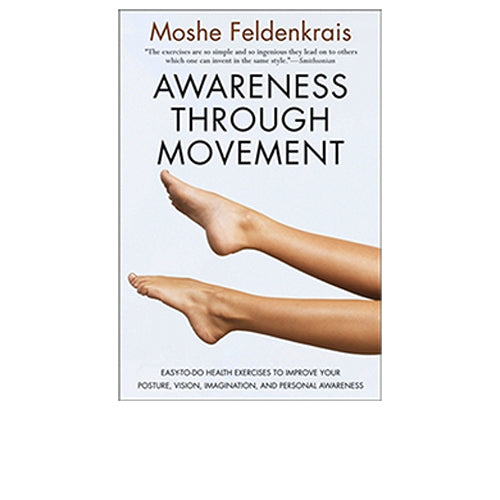
Reading Moshe Feldenkrais’s Awareness Through Movement, I find myself considering a question: how many of our actions do we choose, and how many are simply carried out by habit?
The book brings together discussions of self-image and learning with twelve practical movement lessons. The body becomes both something to observe and a way of understanding ourselves. Through movement, we have an opportunity to notice patterns of participation, tension, and coordination that usually escape our attention.
The Body Holds the Shape of Habit
Every day, we walk, sit down, turn our heads, and reach for things without having to reconsider these actions. Familiarity makes life easier, while allowing the process of acting to slip outside our awareness. I know where I want to go, yet may not know how I get there. I know what I want to accomplish, but rarely notice how much effort I use along the way.
Feldenkrais emphasizes that many ways of acting are learned through experience, and that we retain the possibility of learning them anew. The author’s explanation of his method
This makes me reconsider the phrase, “That’s just the kind of person I am.”
Sometimes it is an honest recognition of ourselves. Sometimes it turns past experience into a boundary for the future. I am accustomed to tension, so I believe I cannot relax. I am accustomed to finishing quickly, so I assume that moving slowly means falling behind. I am accustomed to finding security through effort, so I find it difficult to trust that gentleness might also bring change.
Bodily habits make these abstract judgments visible. My shoulders rise. My breathing is interrupted. A movement that only asks me to turn my head brings other parts of my body into unnecessary tension. Awareness begins with these concrete details, giving me a chance to understand how I act.
Use a Little Less Effort, Leave Room to Feel
What interests me in Awareness Through Movement is its attention to subtle differences. Feldenkrais advocates exploring through slow, gentle, comfortable movements, making details that greater effort can obscure easier to sense. The author’s explanation of the practice principles
I take from this a reminder about effort: effort itself deserves observation.
When things do not go well, my first thought is often to persist a little longer or do a little more. This attitude can help me move forward. At times, though, I may simply be repeating the same approach with greater force. Being busy gives me the feeling that something is happening, without necessarily bringing new understanding.
If I am willing to pause, the questions can change. Where exactly am I encountering difficulty? Which efforts respond to the situation before me, and which merely ease my anxiety? Is there a smaller, clearer step that would help me see the problem first?
Gentleness becomes a condition for learning. It leaves me enough attention to recognize what is happening.
Freediving: Listening to the Body Beyond the Goal
Bringing these ideas into freediving, I think about my relationship with goals.
Depth, time, and distance are clearly defined. They can record progress, and they can easily take over my attention. When a number becomes the only thing on my mind, the body can start to seem like a tool that must obey a plan: do a little better, get a little closer, prove myself once more.
Awareness Through Movement encourages me to bring attention back to the process of acting. Observing connections between parts of the body through gentle movement, and noticing the quality of movement, are central features of the method. An introduction to Awareness Through Movement
For me, this translates into an attitude of observation in freediving. Alongside caring about the result, I can care about how I approach it. Do expectations make me rush? When a movement feels difficult, do I immediately use more force? When my actual condition differs from the plan, can I adjust my decision in time?
These questions do not offer a set of diving techniques, but they help me see my own mindset. Movements in the water may carry habits from life on land: the urgency to finish, the fear of losing progress, the wish to keep everything within expectations.
Water can make these habits especially noticeable. On land, I can cover unease with more activity. In the water, each unnecessary effort more readily enters my awareness. Freediving can become a mirror in which I observe how I respond to uncertainty, limits, and expectations.
This awareness needs to stay alongside clear safety boundaries. Feeling relaxed does not mean being safe. Freediving should take place under the supervision of a qualified buddy or instructor; breath-hold practice should never be done alone.
Freedom in Life Begins Where We Can Choose Again
At this point, freedom begins to feel more concrete to me.
Freedom includes the ability to choose a goal, and the ability to adjust it. It appears in small moments: I am about to respond immediately, but first listen to my emotions. I want to keep accelerating, but recognize that I need rest. I once understood taking a step back as failure, and now allow it to become a considered decision.
Awareness makes habit less invisible. When I can see a reaction unfolding, I gain a little space to decide whether to follow it.
This does not mean we can simply escape every limitation. The body has its conditions, life has its responsibilities, and the underwater world has boundaries that must be respected. Within those real conditions, however, I can still learn to act with greater care, with fewer automatic reactions and more conscious choices.
I want to carry this reminder from Awareness Through Movement into daily life and into my preparation each time I enter the water: observe first, then decide. Let movement become a little clearer. Keep the goal connected to my present condition.
Between the body’s subtle changes, perhaps there is a more grounded kind of freedom to be found: knowing what I am doing, and retaining the ability to choose again.